
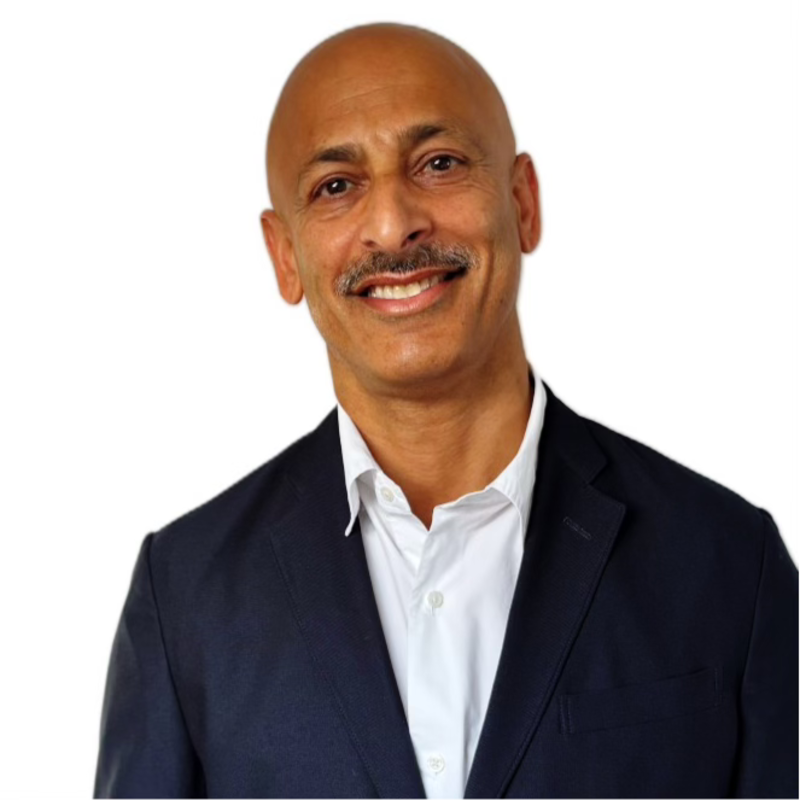
At EVOLVE [26]’s Pioneer’s Stage, Fiaz Sadiq tackled one of the biggest questions on everyone’s mind right now – and delivered some genuinely reassuring news with his talk, AI Is Going to Be OK. As an exited founder and growth specialist who’s spent his career helping businesses turn emerging tech into real, sustainable growth, Fiaz brought a refreshingly optimistic (and honest!) take on where AI is really taking us. Curious how cathedral thinking, better questions, and a bit of bold experimentation could shape the next decade? Read on to hear Fiaz’s take on why the future isn’t something to fear – it’s something to get excited about.
Which talk/panel did you speak at?
Pioneer’s Stage – AI Is Going to Be OK
Can you share a bit about your background?
Exited founder, innovation leader, and growth specialist helping organisations leverage AI, emerging technologies, and innovation to drive sustainable business growth.
What inspired you to speak at EVOLVE [26]?
What inspired me was the growing conversation around whether AI will replace people rather than how it can empower them. I wanted to bring a real-world perspective from working with businesses adopting AI and show that the future is less about replacement and more about augmentation, productivity, and creating new opportunities.
What was the key message or idea you most wanted the audience to take away from your talk?
The main message I wanted the audience to take away was that AI is not something to fear, it’s something to understand and actively engage with.
Every major technology shift has created uncertainty, but history shows that those who adapt, learn, and embrace change are the ones who benefit most. AI will undoubtedly transform how we work and live, but its greatest impact will come from augmenting human capabilities rather than replacing them.
Were there any audience reactions or questions that really stood out to you?
One of the most interesting reactions came from people who admitted they had moved from being sceptical about AI to using it regularly in their work. There was a genuine curiosity about where the technology is heading and how quickly organisations need to adapt.
A question that stood out was whether AI would replace jobs. My response was that, historically, technology changes jobs more often than it eliminates them. The bigger risk is not AI itself, but individuals and organisations choosing not to engage with it and develop the skills needed to work alongside it.
How does the topic you spoke about connect to your current work or passion projects?
For me, it connects directly to both my day job and what I’m passionate about outside of work.
I’ve spent my career helping businesses navigate change, whether that’s innovation, digital transformation, new business models, or emerging technologies. AI is simply the latest chapter in a much bigger story about how people and organisations adapt to change.
I’m a big believer in cathedral thinking. The idea that we plant seeds today for outcomes we may not see for years. When I work with founders, SMEs, corporates, and innovation ecosystems, I’m less interested in the latest AI tool and more interested in how we build the skills, culture, and capability that will matter over the next decade.
That’s why the Evolve26 conversation resonated with me. AI isn’t really a technology discussion; it’s a leadership discussion. It’s about how we prepare people, organisations, and communities for a future that’s arriving faster than many expected.
My passion is helping people move from uncertainty to opportunity. The organisations that will thrive aren’t necessarily those with the most advanced technology, but those that start learning, experimenting, and building today. That’s cathedral thinking in practice.
What emerging trends or challenges in tech (or your field) are you most excited about right now?
What excites me most isn’t AI itself, it’s the convergence of technologies that’s reshaping how value is created. We’re entering an era where AI, robotics, synthetic biology, quantum computing, advanced materials, and decentralised infrastructure are beginning to intersect.
That’s where the real disruption and opportunity sits.
From a deep-tech strategist perspective, I’m particularly interested in three areas.
First, AI moving from copilots to autonomous systems. We’re shifting from tools that assist humans to systems that can reason, orchestrate workflows, and make decisions within defined boundaries. The challenge isn’t the technology, it’s trust, governance, and redesigning organisations to work effectively alongside these systems.
Second, the democratisation of innovation. Start-ups and SMEs now have access to capabilities that were previously only available to large enterprises. AI, cloud infrastructure, digital twins, and no-code platforms are dramatically reducing the cost of experimentation. That creates huge opportunities for founders and innovators willing to move quickly.
Third, sovereign capability and resilience. Whether it’s AI infrastructure, semiconductors, energy, or critical supply chains, nations and organisations are increasingly thinking about long-term strategic advantage. That’s where my cathedral thinking comes in. The winners won’t be those chasing headlines, they’ll be those building capabilities today that compound over the next decade.
The biggest challenge is not technological. It’s human. Skills, leadership, adoption, regulation, and culture are struggling to keep pace with the rate of change. We’ve solved many of the technical problems. The next frontier is helping people and organisations adapt.
If there’s one trend I’m watching closely, it’s the shift from AI as a productivity tool to AI as a strategic capability. Once that happens, the conversation moves from efficiency gains to entirely new business models, markets, and ways of creating value. That’s where things get really interesting.
What advice would you give to someone looking to make an impact in your area of expertise?
Focus on solving meaningful problems, not chasing technology trends.
One thing I’ve learned from being a founder, working in innovation, and advising businesses on emerging technologies is that technology alone rarely creates value. Value comes from understanding a problem deeply enough to build something people genuinely need.
My advice would be:
Develop deep domain expertise. AI and technology can amplify knowledge, but they can’t replace genuine understanding of an industry or market.
Stay close to customers and real-world problems. Innovation succeeds when it delivers tangible outcomes, not when it creates interesting technology.
Learn to bridge disciplines. The future belongs to people who can connect technology, commercial strategy, human behaviour, and execution.
Experiment relentlessly. Most insights come from doing, not debating.
Build for the long term. Relationships, reputation, and expertise compound in much the same way as capital.
The biggest mistake I see is people trying to predict the future with certainty. The better approach is to build the capability to adapt to whatever future emerges.
Ultimately, impact comes from helping others navigate change. Technology will continue to evolve, but the people who create lasting value are those who can translate complexity into opportunity and bring others with them on the journey.
How do you see the future evolving in your industry over the next few years?
We’re moving from an era of digital transformation to an era of intelligent transformation. The question is no longer whether organisations will adopt AI and emerging technologies, but how quickly they can translate them into competitive advantage.
From my perspective as a deep-tech strategist, innovation consultant, and executive coach, the biggest shift will be that technology becomes less of a standalone function and more of a core business capability. AI, automation, advanced analytics, robotics, and synthetic biology will increasingly sit at the heart of business strategy, not on the periphery.
A few trends stand out.
AI will become invisible. Like the internet today, it will be embedded into products, processes, and decision-making rather than treated as a separate technology initiative.
Human capability will become the differentiator. As access to technology becomes more democratised, leadership, adaptability, creativity, and critical thinking will create the real advantage.
Deep tech will move from the lab to the market faster. We’re seeing a compression of innovation cycles, where breakthroughs in AI, biotech, advanced materials, and quantum technologies are reaching commercial applications more quickly than ever before.
Trust, governance, and responsible innovation will become strategic assets. Organisations that can innovate while maintaining trust will outperform those that focus solely on speed.
The greatest challenge won’t be technological. It will be helping people and organisations navigate continuous change. That’s where leadership becomes critical. Leaders will need to be comfortable operating with uncertainty while creating clarity for those around them.
My view is that the next few years will belong to organisations that can combine technological capability with human judgement. Technology will continue to accelerate, but sustainable advantage will come from knowing where to apply it, why it matters, and how to bring people along on the journey.
What was your favourite part of the EVOLVE experience?
Without doubt, it was the conversations between the sessions.
The speakers were excellent, and I took away a number of valuable insights from across the programme, but what stood out most was the quality of the discussions happening around the talks. You had founders, business leaders, technologists, educators, and innovators all bringing different perspectives on the same challenges and opportunities.
What I particularly enjoyed was seeing people move beyond the hype and headlines. Whether the topic was AI, leadership, skills, or innovation, the conversations were increasingly focused on practical application, how we prepare people, organisations, and communities for what’s coming next.
What’s next for you? Any upcoming projects, initiatives, or goals you’re excited to share?
I’m particularly excited to continue contributing to conversations around innovation-led growth, including participating in The Observer Business Roundtable: Manchester’s Blueprint for Growth, The discussion will explore how cities like Manchester can strengthen skills, innovation, entrepreneurship, and deep-tech capability to drive long-term economic growth.
Also delivering with my colleagues Naomi and James The Better Questions Lab, it’s a 90-minute innovation workshop designed around a simple premise: AI is making answers abundant, but the real competitive advantage now comes from asking better questions. Rather than jumping to solutions, participants learn how to identify the problems that are truly worth solving.
The workshop combines systems thinking, emerging technology insights, and commercial value assessment to help leaders reframe challenges, challenge assumptions, and leave with a validated hypothesis and practical experiment, not just a list of ideas.
My older daughter starts university so that’s exciting to watch her grow and write the next chapter.
What’s one book, podcast, or resource that’s inpired you recently?
The book ‘Theo of Golden‘ by Allen Levi
How can people connect with you or follow your work after the event?
linkedin.com/in/fiaz-sadiq-profile
Anything else you would like to share with our community?
Great to part of the Evolve community.